SOKIOVOLA Foldable Solar Panels

SOKIOVOLA builds foldable solar panels from 100W to 400W using A+ grade N-type 16BB monocrystalline cells — the same cell technology found in premium-priced panels, without the markup. Every model ships with a multi-adapter cable covering five connector types, so it connects natively to EcoFlow, Jackery, Bluetti, Rockpals, and most other popular power stations right out of the box. One YouTube reviewer measured 90W of actual output from the 100W model; a verified buyer clocked 24.8% real-world efficiency — slightly above the stated 25% STC rating, which is rare at this price point. If you've been burned by a panel that never came close to its rated wattage, the N-type cell advantage and ETFE surface coating are worth understanding before you buy.

✓ 25% N-Type Efficiency✓ IP68 Panel Surface✓ 5 Connector Types Included
Shop SOKIOVOLA Solar Panels on Amazon →
SOKIOVOLA N-Type 16BB 200W Portable Solar Panel for EF/Jackery/Bluetti/Anker Power Station Foldable Solar Panel 25% High Efficiency IP68 Waterproof for Outdoor Trip RV Camping Blackout Off Grid
25% Efficiency From Real N-Type Cells 25% Efficiency From Real N-Type Cells

Independent testing measured 90W of actual output from the 100W model and 24.8% real-world efficiency — results that meet or slightly exceed the stated 25% STC rating, which almost never happens with P-type polycrystalline panels at comparable prices.

ETFE Holds Up Where PET Film Fails ETFE Holds Up Where PET Film Fails

SOKIOVOLA uses ETFE lamination with up to 98% light transmittance — a fluoropolymer surface that resists UV yellowing and stays optically clear after years of outdoor use, unlike the PET film used on most competing panels at this price.

IP68 Panel Surface on 4 of 5 Models IP68 Panel Surface on 4 of 5 Models

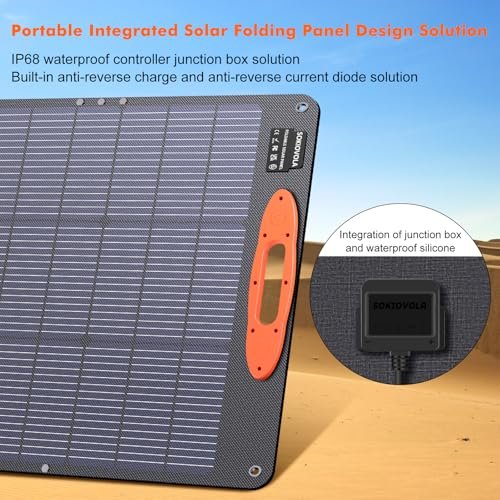
The panel surface on the 100W, 110W, 200W, and 220W carries an IP68 waterproof rating — continuous submersion protection, not just splash resistance; keep the controller pocket sheltered during heavy rain, as it carries a separate rating.

Five Connector Types Ship in the Box Five Connector Types Ship in the Box

Every SOKIOVOLA panel includes a multi-adapter cable covering XT60, Anderson, DC5521, DC7909, and DC8020 connectors — named compatibility with EcoFlow RIVER/DELTA series, Jackery Explorer 160 through 3000 Pro, Bluetti EB-series, Anker 521, Rockpals, and Goal Zero Yeti.

SOKIOVOLA Solar Panels From 100W to 400W

Five foldable panels, one shared platform — A+ grade N-type 16BB monocrystalline cells, ETFE lamination, and MC4 output across every model. The differences that matter are wattage, weight, folded footprint, and which connector bundle ships in the box — all of which determine whether a given panel fits your setup.

SOKIOVOLA N-Type 16BB 100W Portable Solar Panel 18V ETFE Portable Foldable Solar Charger NextGen 25% High Conversion Folding Solar Panel for Camping Outdoor RV

100W Foldable Panel (Medium Gray)

At 8.81 lbs and folding to 21×23 inches, the 100W is the lightest panel in the lineup with practical camping wattage. It ships with the most comprehensive adapter bundle SOKIOVOLA offers — a 4-in-1 MC4 cable plus a 9-in-1 DC adapter set and a separate DC8020 adapter — covering more power station models than any other panel in the lineup. The slightly convex ETFE surface increases sun contact area beyond what a flat panel achieves at the same footprint.

Best starting point for first-time buyers and weekend campers pairing with a 100–500Wh power station — it's the lightest SOKIOVOLA panel with usable wattage and the most thorough adapter kit in the box.

See on Amazon
SOKIOVOLA N-Type 16BB 110W Portable Solar Panel for EF/Jackery/Bluetti/Anker Power Station

110W Foldable Panel (Light Gray)

The 110W sits just above the 100W in output but delivers marginally higher short-circuit current — 6.73A versus 6.12A — which can make a measurable difference under partial shading or inconsistent sun. Folded dimensions are 22.24×23 inches, a fraction wider than the 100W, and it carries the same 4-in-1 plus 9-in-1 DC adapter bundle. The magnetic handle makes one-handed carrying noticeably easier in the field. Note: the Amazon listing shows a weight discrepancy between spec fields; check the current Amazon listing for the confirmed figure before purchase.

The right choice if you want a small wattage buffer over the 100W without stepping up to the larger 200W footprint — same adapter coverage, slightly higher current output.

See on Amazon
SOKIOVOLA N-Type 16BB 200W Portable Solar Panel for EF/Jackery/Bluetti/Anker Power Station Foldable Solar Panel 25% High Efficiency IP68 Waterproof for Outdoor Trip RV Camping Blackout Off Grid

200W Foldable Panel (Orange)

The 200W delivers the highest wattage in the lineup within a compact 21×23-inch folded footprint — 16.31 lbs is heavier than the smaller models but manageable for car camping and RV use. Four mounting holes let it attach directly to an RV roof or vehicle rack. The 5-in-1 cable includes all five connector types, giving it broader out-of-box compatibility than the 400W flagship. A carry bag ships in the box. The product listing honestly notes it may be heavy for long backpacking trips — worth factoring in if that's your use case.

Best mid-range option for RV weekenders and overlanders charging a 500–1,000Wh station — highest wattage in the compact fold size, with RV mounting holes and the widest connector bundle in the lineup.

See on Amazon
SOKIOVOLA N-Type 16BB 220W Portable Solar Panel for EF/Jackery/Bluetti/Anker Power Station

220W Foldable Panel (Gray)

The 220W runs at a 20V operating voltage and carries a higher open-circuit voltage of 24V — unique in the SOKIOVOLA lineup and worth verifying against your power station's maximum solar input spec before ordering. At 17.08 lbs with a 5-in-1 cable, four RV mounting holes, and a carry bag, it covers the same use cases as the 200W but adds 20W of headroom and a slightly longer unfolded surface at 83.26 inches. The same adapter kit as the 200W ships in the box. Note: the Amazon tech spec weight field shows an apparent data error; the product overview confirms 17.08 lbs.

The right pick for RV travelers who want a step above the 200W without the larger footprint of the 400W — but check your station's maximum Voc input spec first, since the 24V open-circuit voltage is higher than the 200W's 21.6V.

See on Amazon
SOKIOVOLA 400W Portable Solar Panel for EF/Jackery/Bluetti/Anker Power Station

400W Foldable Panel (Cement Gray)

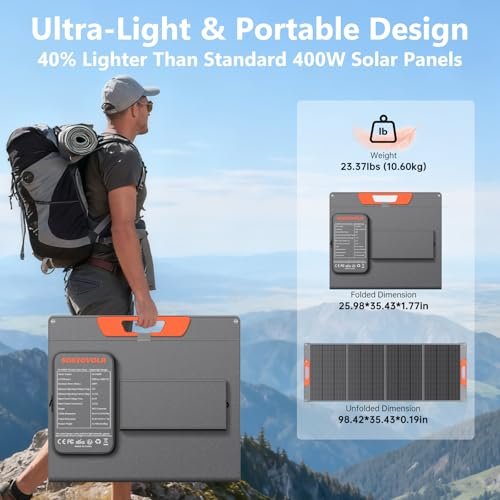
The 400W is a different tier entirely — 23.37 lbs, folding to 25.98×35.43×1.77 inches, with four adjustable kickstands that angle the panel for up to 25% more sunlight capture than a flat-laid panel in the same position. ETFE transmittance reaches ≥98%, the highest stated figure in the lineup. Operating voltage is 36V with a Voc of 43.2V — verify your power station's maximum solar input voltage before pairing, especially if you're considering chaining panels. This is the only SOKIOVOLA model rated IP67 rather than IP68, and it ships with a 4-in-1 cable that doesn't include the DC5521 adapter.

Built for full-time RV travelers, van-lifers, and emergency prep setups that need to push 1,000+ Wh daily — but its 43.2V open-circuit voltage requires a compatibility check against your power station's maximum solar input spec before purchase.

See on Amazon

Which SOKIOVOLA Panel Fits Your Setup

Five models share the same N-type 16BB cell platform, but wattage, weight, folded size, and cable contents differ enough that picking the wrong one is a real possibility. This table puts the key decision variables side by side so you can match panel to use case without reading five separate product listings.

Spec 100W 110W 200W 220W 400W
Max Power (STC) 100W 110W 200W 220W 400W
Typical Real-World Output 70–90W 75–95W 145–165W 160–180W 290–340W
Weight 8.81 lbs See Amazon listing 16.31 lbs 17.08 lbs 23.37 lbs
Folded Size (inches) 21 × 23 22.24 × 23 21 × 23 23 × 22.24 25.98 × 35.43 × 1.77
Unfolded Size (inches) 42 × 23 44.58 × 23 78.68 × 23 83.26 × 23 98.42 × 35.43
Operating Voltage 18V 18V 18V 20V 36V
Open-Circuit Voltage (Voc) 21.6V 21.6V 21.6V 24V 43.2V
Short-Circuit Current (Isc) 6.12A 6.73A 12.23A 12.1A 12.22A
IP Rating (Panel Surface) IP68 IP68 IP68 IP68 IP67
ETFE Transmittance 95%+ 95%+ 95%+ 95%+ ≥98%
Kickstands 2 built-in brackets 2 built-in brackets Adjustable kickstand Adjustable kickstand 4 adjustable kickstands
RV Mounting Holes No No Yes (4 holes) Yes (4 holes) No
Cable Type 4-in-1 MC4 4-in-1 MC4 5-in-1 MC4 5-in-1 MC4 4-in-1 MC4
DC5521 Adapter Included Yes Yes Yes Yes No
9-in-1 DC Adapter Kit Yes Yes No No No
Carry Bag Included No No Yes Yes No
Best For Weekend camping, first-time buyers Slight wattage buffer over 100W RV, basecamp, overlanding RV, step-up from 200W Full-time RV, emergency backup

The 100W and 110W are near-identical in folded size — the 110W's real advantage is higher short-circuit current (6.73A versus 6.12A), which matters under partial shading. The 200W and 220W follow the same logic: same footprint class, 20W gap, but the 220W's 24V Voc means you need to confirm your power station's maximum solar input voltage before ordering. The 400W is its own tier — check the 43.2V Voc against your station's spec sheet before purchasing.

How to Match Wattage to Your Actual Setup

The right wattage isn't the highest you can afford — it's the number that matches what your power station can actually accept and what you realistically consume per day. A 400W panel pushing into an EcoFlow River 2 with a 65W solar input cap delivers exactly 65W regardless of sunlight. Start with your station's spec sheet, not the panel's marketing copy.

Phone and GPS charging on trail

If your goal is keeping a phone, GPS unit, and maybe a headlamp battery topped up across a multi-day backcountry trip, the 100W is more panel than you likely need from a pure wattage standpoint — but it's the lightest SOKIOVOLA option with practical output, folding to 21×23 inches and weighing 8.81 lbs. Honest answer: if weight is a hard constraint and you're only charging USB devices, a smaller panel in the 28–50W range may serve you better. The 100W earns its place when you're pairing with a 100–300Wh power station that can store the day's generation.

Keeping a 300–500Wh station topped up at a car camp

This is where the 100W and 110W operate best. In a typical clear summer day with 4–5 peak sun hours, the 100W delivers roughly 280–400Wh — enough to keep a 300Wh station near full and have some left over for device charging. The 110W adds about 10W of headroom and slightly higher current output, which helps when clouds roll in and partial shading becomes a factor.

Recharging a 500–1,000Wh station in a day

To realistically refill a 1,000Wh station from 20% to 80% in a single day, you need roughly 600–700Wh of panel generation. At 4 peak sun hours and 75% real-world efficiency, that requires around 200W of rated panel capacity — which puts the 200W and 220W models squarely in range. The 200W folds to 21×23 inches at 16.31 lbs, making it manageable for vehicle transport. Both models include 4 RV mounting holes and a carry bag.

Sokiovola solar panels - Man carrying folded 220W solar panel bag from RV motorhome with 25% efficiency N-Type TOPCon 16BB so

One thing to check first: your station's maximum solar input wattage. Some 1,000Wh stations cap at 200W solar input, others at 65W. The panel doesn't create that limit — the station does.

Full-time RV or van life daily power

Running a 12V compressor fridge (~40–50W continuous draw), charging a laptop once daily (~60–90Wh), and keeping phones and lights topped up adds up to roughly 400–700Wh per day depending on how aggressively everything runs. The 400W panel, angled with its four adjustable kickstands for up to 25% more capture than flat placement, generates 800–1,200Wh on a good sun day. That's the right tier — but the 43.2V Voc requires a power station rated to accept it.

Emergency home backup during a grid outage

The critical variable for emergency prep isn't daily generation — it's what you're trying to power and for how long. A 200W panel paired with a 1,000Wh power station can run a 40W camp fridge for roughly 20 hours and charge phones indefinitely. For a multi-day outage where you want to maintain a full-size refrigerator and medical devices, two 200W panels or a single 400W paired with a 2,000Wh+ station is the minimum realistic setup. The 220W's 24V Voc is worth double-checking against any station you're considering for this application.

Wattage selection reference

Use Case Recommended Model Why
Phones, GPS, headlamps while hiking 100W Lightest practical option; pairs with 100–300Wh station
Weekend car camp, 100–500Wh station 100W or 110W 280–400Wh daily generation; fits most station input caps
Basecamp or overlanding, 500–1,000Wh station 200W or 220W 450–600Wh daily generation; RV mounting holes included
Full-time RV or van life 400W 800–1,200Wh daily; kickstands optimize angle; verify 43.2V Voc
Emergency home backup, multi-day outage 200W–400W Depends on paired station capacity; check station solar input cap

What to Expect From Real-World Output

A YouTube reviewer testing the SOKIOVOLA 100W measured 90W of actual output in direct sun — "a little higher than I expected," they noted. A verified buyer on Amazon independently clocked 24.8% real-world efficiency. Those are genuinely good results. But they require full, unobstructed sun, a panel angled perpendicular to the sun, and a power station capable of accepting the full input. Miss any of those conditions and the numbers drop.

Here's the honest breakdown of why rated wattage and field wattage diverge, and what you should actually expect from each SOKIOVOLA panel.

STC ratings versus field conditions

Every solar panel wattage rating — 100W, 200W, 400W — is measured under Standard Test Conditions: 1,000 watts of irradiance per square meter, 25°C cell temperature, and a specific air mass coefficient. Those conditions exist in a laboratory. In the field, you'll face lower irradiance on hazy days, cell temperatures that climb well above 25°C in summer sun, and angles that shift as the day progresses.

The practical result: expect 70–85% of rated wattage under good conditions. That means the 100W delivers roughly 70–90W, the 200W delivers roughly 145–165W, and the 400W delivers roughly 290–340W when things are working well. Cloudy days drop that further — often to 20–40% of rated output.

Peak sun hours and daily Wh estimates

Watt output at a given moment matters less than total watt-hours generated across a day. That number depends on peak sun hours — a regional figure representing equivalent full-sun exposure. Here's how it works in practice for the 200W panel:

  • Phoenix, AZ (5.5–6.5 peak sun hours): 200W × 0.75 real-world factor × 6 hours = roughly 900Wh/day
  • Denver, CO (4.5–5.5 peak sun hours): 200W × 0.75 × 5 hours = roughly 750Wh/day
  • Seattle, WA (3.0–4.0 peak sun hours): 200W × 0.75 × 3.5 hours = roughly 525Wh/day
  • Miami, FL (5.0–6.0 peak sun hours): 200W × 0.75 × 5.5 hours = roughly 825Wh/day

Apply the same formula to any model: multiply rated wattage by 0.75, then multiply by your regional peak sun hours. That gives you a realistic daily generation estimate to plan against.

Sokiovola solar panels - 400W foldable solar panel shown from front and back angles with included cable accessories on white

What temperature does to output

Solar cells lose efficiency as they heat up. On a 90°F summer day, a dark ETFE panel surface in direct sun can reach 50–60°C — meaningfully above the 25°C used in STC ratings. The practical effect is another 5–10% reduction from the already-adjusted real-world estimate. Not a defect, just physics. Plan for it when you're calculating whether the 200W or 400W is the right call for a summer RV trip.

Shade is more damaging than clouds

A solid overcast reduces output proportionally — roughly in line with how bright the sky looks. Partial shading is different. A single shadow across one section of the panel, even a tent guyline or your own shadow for five minutes, can cut total output by 40% or more due to how solar cells are wired in series. Position the panel in completely unobstructed sun. Check its angle every hour or two as the sun moves — the four kickstands on the 400W model make this easier than manually repositioning a flat panel.

Your power station's input cap matters as much as the panel

This deserves its own section below, but it's worth flagging here: if you buy a 200W panel and your power station caps solar input at 65W, you will see 65W regardless of conditions. The panel is performing correctly. The station is the limiting factor. Check the spec sheet for your specific station model before choosing panel wattage — this is the single most common source of post-purchase disappointment in portable solar.

Why Your Station Caps Output Below Panel Wattage

The most persistent complaint in portable solar — "my 200W panel is only delivering 65W" — is almost never a panel problem. It's a power station input limit. Every portable power station has a maximum solar input wattage built into its charge controller, and that cap is absolute. A panel delivering 200W into a station rated for 65W solar input will always show 65W at the station. The extra wattage goes nowhere.

SOKIOVOLA's product listings include three separate warning paragraphs about this. It's not fine print — it's the most important spec to verify before you buy any combination of panel and station.

Known input caps for common power stations

These are manufacturer-stated limits. When a SOKIOVOLA panel produces more than the station's cap, the station simply doesn't draw the excess.

Power Station Max Solar Input SOKIOVOLA Panel That Fits
EcoFlow River 2 65W 100W or 110W (panel output exceeds cap — station limits draw to 65W)
EcoFlow River 2 Pro 100W 100W matches; 200W still limited to 100W input
EcoFlow Delta 2 500W Any SOKIOVOLA panel; 400W well within limit
Jackery Explorer 500 65W 100W or 110W; larger panels waste capacity
Jackery Explorer 1000 200W 200W is the natural match; 400W limited to 200W draw
Jackery Explorer 2000 Pro 600W 400W well within limit; could run two 200W panels
Bluetti EB3A 200W 200W matches; 220W slightly exceeds but station caps at 200W
Bluetti AC200P 700W 400W well within limit; two 200W panels possible
Anker 521 65W 100W; 200W would be capped at 65W

These figures come from manufacturer specifications. Verify your specific model before ordering — stations within the same product family sometimes have different caps across generations.

Sokiovola solar panels - Man in outdoor jacket setting up foldable 110W solar panel on green grass near tent with mountain la

Voc compatibility is a separate check from wattage

Beyond wattage limits, every power station also has a maximum solar input voltage — and this one isn't just about efficiency, it's about safety. Exceeding a station's maximum Voc can damage the charge controller permanently.

The 100W, 110W, and 200W SOKIOVOLA panels all carry a 21.6V open-circuit voltage — safely within the input spec of virtually every portable power station on the market. The 220W steps up to 24V Voc, and the 400W sits at 43.2V. Before pairing either of those models with your station, look up "maximum PV input voltage" or "maximum solar input voltage" in your station's manual and confirm the number exceeds the panel's Voc.

Chaining panels makes the Voc math critical

If you connect two SOKIOVOLA panels in series — which the product listings explicitly support — the Voc values add together. Two 100W panels in series produce a combined Voc of 43.2V. Two 220W panels in series produce 48V. Before chaining any panels, confirm your station's maximum solar input voltage covers the combined Voc. For parallel connections, voltage stays the same but current doubles — a different set of considerations, but voltage compatibility is less of a concern.

The 400W panel's standalone 43.2V Voc already requires a station rated for at least 45V solar input. Most entry-level portable stations cap at 30V or lower. Check before you buy.

Questions About SOKIOVOLA Solar Panels Answered

Will a 200W solar panel run a fridge?

The SOKIOVOLA 200W panel can keep a 12V compressor camping fridge running indefinitely on a sunny day — a typical 12V compressor fridge draws 40–50W, and the 200W delivers roughly 145–165W in real-world conditions. The caveat is that you're not running the fridge directly from the panel; you're running it from a power station the panel charges. Size your station at 500Wh or more to bridge overnight hours when the panel isn't generating. A 200W panel on a 5-hour peak sun day generates roughly 750Wh — enough to run a 50W fridge for about 15 hours and leave headroom for device charging.

How much power will a 200W solar panel produce?

The SOKIOVOLA 200W panel produces roughly 145–165W in direct, unobstructed sunlight — about 75–82% of its 200W STC rating. Across a full day, multiply that by your regional peak sun hours: Denver averages 4.5–5.5 peak sun hours, yielding roughly 650–750Wh daily; Phoenix averages 5.5–6.5 hours, yielding 800–900Wh. Cloudy conditions drop output to 20–40% of rated capacity. Your power station's solar input cap is the other variable — if it limits solar to 65W, that's what the station will accept regardless of panel output.

What is the 33% rule in solar panels?

The 33% rule is a charge controller sizing guideline: don't pair a controller rated for less than 133% of your panel's short-circuit current. In practice, this means if your SOKIOVOLA 200W panel has an Isc of 12.23A, your charge controller should handle at least 16.3A. This rule applies when connecting SOKIOVOLA panels directly to a 12V battery bank via a standalone MPPT charge controller — not when plugging into a portable power station with a built-in controller. Most portable stations handle this internally, so the 33% rule is only relevant for DIY battery-bank setups.

Which is better, TOPCon or bifacial for portable panels?

TOPCon is a cell architecture built on N-type silicon — which is the same cell technology SOKIOVOLA uses in its 16BB N-type monocrystalline panels. Bifacial panels capture light from both faces and are almost exclusively found in rigid, permanently mounted residential arrays. Foldable portable panels are single-face by design — they fold flat for transport, which makes bifacial construction impractical. For portable solar, the relevant comparison is N-type versus P-type monocrystalline: N-type cells degrade more slowly, perform better in heat, and maintain higher efficiency over time. That's the advantage SOKIOVOLA's panels carry.

Do SOKIOVOLA panels work with my power station?

The 100W, 110W, 200W, and 220W SOKIOVOLA panels include a 4-in-1 or 5-in-1 adapter cable covering XT60 (EcoFlow RIVER/DELTA series), Anderson (Jackery Explorer 1000, Rockpals 300W), DC5521 (Rockpals 250/350/500W, FlashFish), and DC7909 (Jackery 160–1000, Bluetti EB70/EB55/EB3A, Anker 521). The 400W ships without the DC5521 adapter. The 100W and 110W also include a 9-in-1 DC adapter kit for extended compatibility. One critical check: look up your station's maximum solar input wattage and maximum input voltage before ordering — both caps are determined by the station, not the panel.

How do you choose the right wattage solar panel for camping?

Start with your power station's solar input cap — that number sets the ceiling regardless of which panel you buy. Then estimate your daily consumption: a phone charges on about 15–20Wh, a laptop needs 60–90Wh per charge, a 12V camping fridge runs 40–50W continuously. For weekend car camping with a 300–500Wh station, the 100W or 110W is the right range. For basecamp or RV use with a 1,000Wh station, the 200W or 220W generates enough daily to refill from 20% to near-full on a clear day. The 400W is for full-time travelers who need 800–1,200Wh daily.

Are SOKIOVOLA solar panels waterproof?

The panel surfaces on the 100W, 110W, 200W, and 220W SOKIOVOLA models carry IP68 ratings — continuous submersion protection, the highest waterproof level assigned to foldable solar panels. The 400W model is rated IP67 on its panel surface, which covers rain, snow, and dust storms but with slightly lower submersion specification. The important caveat across all models: the controller and junction box stored in the side pocket carry their own separate rating and should be kept sheltered during heavy rain. The ETFE-laminated panel surface handles outdoor weather; the pocket with the wiring connections should stay dry.

What is the 120% rule for solar panels?

The 120% rule applies to residential grid-tied solar installations in the US, where the National Electrical Code allows a solar system to feed up to 120% of a breaker panel's busbar rating. It's a calculation used by licensed electricians when sizing residential arrays. This rule has no direct application to portable foldable solar panels like SOKIOVOLA's lineup — portable panels connect to standalone power stations or charge controllers, not to home electrical panels. If you're using SOKIOVOLA panels for home backup through a portable station, the relevant limits are the station's solar input cap and maximum Voc, not the NEC 120% rule.

Can you chain multiple SOKIOVOLA panels together?

Yes — the product listings for the 100W, 110W, and 220W panels explicitly highlight series and parallel connection as a supported feature. Series connections add voltage (Voc values stack); parallel connections add current while voltage stays constant. Before chaining, verify your power station's maximum solar input voltage covers the combined Voc. Two 100W panels in series produce 43.2V combined — confirm your station accepts that. Two 220W panels in series produce 48V combined Voc, which exceeds many stations' input ratings. The 400W panel's standalone Voc of 43.2V already requires a station rated for at least 45V solar input.

Why are SOKIOVOLA solar panels showing lower output than rated?

Three things account for almost every case of output below rated wattage. First, STC ratings are laboratory measurements — real-world output is typically 70–85% of rated wattage in good sun. Second, partial shading of even one panel section can cut total output by 40% or more. Third, your power station's solar input cap is the most common hidden culprit: a station capped at 65W will draw only 65W from a 200W panel regardless of sunlight. Confirm your station's max solar input spec, position the panel in unobstructed direct sun, and adjust the angle toward the sun — most "underperformance" resolves with those three checks.

SOKIOVOLA Warranty, Support and Refund Terms

Every SOKIOVOLA panel ships with a 12-month warranty from the purchase date, a 30-day full refund window, and a stated 12-hour customer response commitment. Those are the three numbers to know before you buy.

Twelve months is the standard warranty term for foldable portable solar panels in this segment. Renogy's foldable suitcase panels carry a 2-year warranty, which is the longest widely available in the portable category. Rigid residential panels from major manufacturers typically carry 10–25 year performance warranties, but those are fixed-mount glass panels — a different product class entirely. For a foldable panel designed for active outdoor transport, 12 months with a 30-day refund backstop is category-normal, not exceptional.

The 30-day full refund window is genuinely useful. Foldable solar panels are one of the harder products to evaluate without actually testing in your specific conditions — cell angle, regional sun hours, power station compatibility, and how the folded size fits in your vehicle are all variables that spec sheets can't fully answer. A 30-day window gives you one camping season's worth of weekend trips to verify the panel works for your setup before the return window closes.

Sokiovola solar panels - 200W portable solar panel shown folded and unfolded with measurements 21.25x23.62x2.36 inches and 78

What the warranty covers

The warranty covers manufacturing defects in materials and workmanship. It doesn't cover physical damage from misuse, water damage to the controller junction box caused by direct submersion (which carries its own waterproof rating, separate from the IP68 panel surface), or performance degradation from normal use. If you have a problem during the warranty period, SOKIOVOLA's stated response time is within 12 hours of contact — faster than most Amazon-native brands in this category publish as a commitment.

One honest limitation to know upfront

The 12-month warranty means if a panel develops an efficiency issue in month 14, you're outside the coverage window. For a panel that's living in a vehicle cargo area and getting deployed 40 weekends a year, that's worth thinking about. The ETFE lamination and N-type cell construction are more durable than PET-film P-type alternatives over time — but no foldable panel carries the longevity guarantees of a rigid framed panel. Buy it for the use case it's designed for: portable, active deployment. Don't expect it to perform identically to a rooftop installation after five years of hard use.

To reach customer support, check the current contact details on the SOKIOVOLA Amazon store page or the product listing. The 12-hour response commitment applies to inquiries submitted through the Amazon messaging system or the contact method listed on your order confirmation.

Why SOKIOVOLA Builds Foldable Panels With N-Type Cells

SOKIOVOLA entered the portable solar market as an Amazon-native brand with a specific bet: that buyers in the mid-tier foldable panel segment were being systematically undersold on cell quality. Most panels at this price point used P-type polycrystalline cells under PET film — a combination that got the job done on paper but degraded faster, ran less efficiently in heat, and used a surface coating that yellowed within a season or two of real outdoor use. SOKIOVOLA's answer was to build around A+ grade N-type 16BB monocrystalline cells and ETFE lamination across every model in the lineup, from the 100W trail panel to the 400W flagship. That's not a premium-tier spec list — it's a mid-tier panel built to the component standards that buyers at higher price points take for granted.

The results show up in independent testing. A YouTube reviewer measuring the 100W model pulled 90W of actual output — higher than expected at that wattage. A verified buyer on Amazon independently measured 24.8% real-world efficiency, slightly above the stated 25% STC rating. Those numbers don't happen by accident. They happen when the cell architecture — 16 busbars cutting electron travel distance, N-type silicon resisting light-induced degradation, ETFE holding optical clarity through UV exposure — is doing what it's supposed to do. Reddit's r/OffGrid and r/SolarDIY communities place SOKIOVOLA in the same conversational tier as FlexSolar and Ecosonique: above generic no-name panels, worth recommending when someone asks for a reliable mid-market option that doesn't require a premium brand markup to justify the purchase.

The lineup covers five wattage points from 100W to 400W, all sharing the same core platform. SOKIOVOLA sells exclusively through Amazon in the US market, which means every purchase ships through Amazon's fulfillment infrastructure with the review accountability that entails. The brand's product copy does something rare in this category — it honestly acknowledges limitations. The 200W listing notes the panel "may be a bit heavy for long backpacking trips or hiking." That kind of disclosure doesn't come from a brand trying to oversell. It comes from one that expects the buyer to actually use the product and wants them to choose the right model before they unbox it.

How to Chain SOKIOVOLA Panels Safely

The 100W, 110W, and 220W product listings explicitly call out series and parallel panel connections as a supported feature. Chaining panels makes sense when your power station accepts more solar input than a single panel can deliver, and you want to maximize daily generation without buying a larger panel. But series and parallel connections behave differently — and getting the Voc math wrong in a series setup can permanently damage your power station's charge controller.

Series versus parallel connections

In a series connection, panels are wired positive to negative in a chain. Voltage adds up; current stays the same as a single panel. Two 100W SOKIOVOLA panels in series produce a combined open-circuit voltage of 43.2V (21.6V + 21.6V), with the same 6.12A short-circuit current as one panel. In a parallel connection, panels are wired positive to positive and negative to negative. Current doubles; voltage stays the same as a single panel. Two 100W panels in parallel stay at 21.6V Voc but produce 12.24A combined current.

The practical difference matters for power station compatibility. Voltage limits are the hard constraint — exceed a station's maximum solar input voltage with a series connection and you risk controller damage. Current limits are softer; most stations simply won't draw more than their rated input current, so a parallel connection that produces excess current is generally safe, just inefficient. Series connections deliver more voltage to overcome longer cable runs or charge higher-voltage batteries more efficiently. Parallel connections stay within low-voltage specs and work well when your station accepts the combined wattage but has a modest Voc limit.

Voc math for every chaining combination

Before chaining any SOKIOVOLA panels, calculate the combined Voc for your intended configuration and compare it to your power station's maximum solar input voltage spec. Here's the math across the lineup:

Configuration Combined Voc (Series) Combined Voc (Parallel) Min. Station Voc Rating Needed (Series)
Two 100W panels 43.2V 21.6V 45V+
Two 110W panels 43.2V 21.6V 45V+
Two 200W panels 43.2V 21.6V 45V+
Two 220W panels 48V 24V 50V+
400W panel (standalone) 43.2V N/A 45V+

The 220W's 24V Voc makes series chaining particularly important to verify. Two 220W panels in series produce 48V — which exceeds the maximum solar input voltage of many portable stations, including several EcoFlow and Jackery models with 30V limits. The EcoFlow Delta 2 accepts up to 60V solar input and handles two 220W panels in series with room to spare. The Jackery Explorer 1000 is rated for 30V maximum — a single 220W panel at 24V is fine; two in series at 48V is not.

Sokiovola solar panels - 100W foldable solar panel dimensions shown folded and unfolded at 8.81 pounds with measurements 21x2

When to chain versus when to buy up in wattage

Chaining two 100W panels in parallel costs you two cables, two panel footprints, and the complexity of managing two separate units — but delivers roughly 140–165W of combined real-world output into a station rated for it. A single 200W panel delivers the same 145–165W range in a single folded unit. The math usually favors buying up in wattage unless you already own one panel and want to add capacity incrementally.

Series chaining makes more sense when the goal is reaching a higher operating voltage for a 12V battery bank setup via a standalone MPPT charge controller — the higher voltage improves charging efficiency over longer cable runs. For plug-and-play power stations, parallel or single-panel setups are simpler and carry less risk of voltage spec mismatch. If you're not certain your station handles the combined Voc, run parallel or stick to a single higher-wattage panel.

One check that prevents most problems

Look up "maximum PV input voltage" or "maximum solar input voltage" in your power station's manual before connecting any panels in series. That number — not the wattage cap — is the limit that causes hardware damage when exceeded. Wattage limits are enforced by the station drawing less current; voltage limits are not self-regulating in the same way. The 400W panel's 43.2V Voc is already at the edge of what many portable stations accept as a single panel. Two panels in series from anywhere in this lineup should be verified before deployment, not assumed safe.

Watch the Sokiovola 200W Panel Get Tested

This 23-minute hands-on review covers the Sokiovola 200W foldable solar panel from unboxing through real-world output testing. You'll see the N-type Topcon cell construction and ETFE surface up close before the panel is put under load. The reviewer tests actual watt output so you can compare rated specs against field performance. It's a useful watch before committing to the 200W model for camping, RV use, or home backup.

About SOKIOVOLA

SOKIOVOLA is an Amazon-native solar panel brand selling foldable N-type panels in the US market. The full lineup — 100W through 400W — is available through the official SOKIOVOLA Amazon store. All five models are fulfilled through Amazon and listed as in stock.

Visit the SOKIOVOLA Amazon Store →

Customer Support

SOKIOVOLA commits to responding within 12 hours of any support inquiry. Contact the brand through the messaging system on your Amazon order confirmation or through the product listing's "Ask a question" feature. For pre-purchase compatibility questions — particularly around power station input specs and connector types — the product listings include detailed compatibility tables that cover most common stations.

Warranty and Returns

Every SOKIOVOLA panel ships with a 12-month warranty from the date of purchase covering manufacturing defects in materials and workmanship. A 30-day full refund window applies from the purchase date — long enough to test the panel in your actual conditions before the return window closes. Warranty service and return requests are handled through Amazon's standard process for orders placed through the official store.